A medical syringe has a needle attached to a hollow cylinder which is used to inject or withdraw fluid from the body. The hollow cylinder has a sliding plunger which when moved downwards, helps in injecting the fluid and the upward movement withdraws fluid. There was a time when medical syringes were made of metal or glass, and these syringes required a lot of cleaning and sterilization before they could be used again. But now most syringes are disposables ones made of plastic and it is advisable to buy disposable syringes instead of using the older generation glass syringes after re-sterilizing them to avoid prevalent danger of infectious diseases.
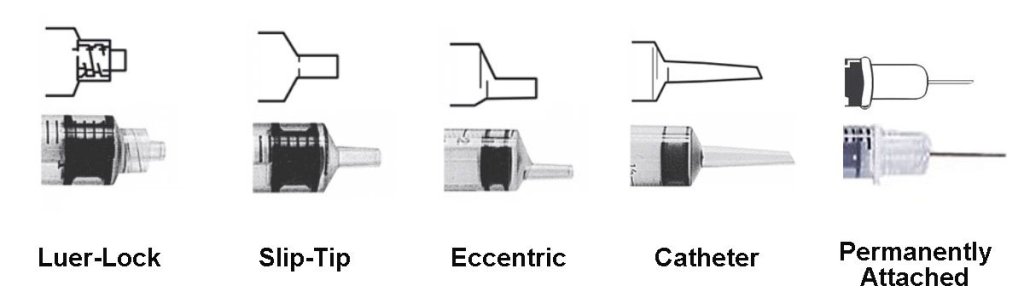
Syringes are classified based on the tip as follows:
- Luer Lock: The needles in the Luer-Lok syringes can be twisted and locked into the place and can be fitted in the tips of Luer-Lok syringes.
- Luer Slip Tip: A friction-fit connection, the needle hub has to be pushed onto the syringe, this will ensure a connection that is likely to detach.
- Eccentric Luer Slip Tip: These syringes are used for vein punctures and not penetrating both vascular walls of the vein
- Catheter Tip: These are used for cleaning catheters, gastrostomy tubes, and other devices. These are similar to Luer slip tips but with longer and tapered tips.
- Syringe with a permanently attached needle: These syringes are often used for low doses and can be disposed of after using them. This syringe type is popular with Insulin Syringes and Tuberculin Syringes.
There are a few things to keep in mind when you are buying insulin syringes:
- Small in size, hold between 0.3 and 1 ml of medication.
- They are meant to be used for one time only and then disposed.
- The size of the syringe depends on the dose and for different doses, different syringes would be needed.
- Used to give subcutaneous injection or just under the skin.
Features of Tuberculin Syringes are as follows:
- Small in size, hold up to 1 ml of fluid.
- Has a long thin barrel with a pre-attached needle used for tuberculosis testing.
- These syringes are injected right into the skin (intradermal vaccine).
Selecting the right Needle
A needle is designed in such a way that it has a hub which attaches it to a syringe, a hollow center and a sharp point that makes cutting or puncturing easier. Some needles also come with a cap which has to be removed before using the needle.
Three important things to know before buying needles is about the use the length and the gauge.
Needle Use: The needle use refers to how deep the needle must be inserted to reach the area that is to be injected. The depth of these injections include
intradermal (dermis injections), subcutaneous (subcutaneous tissue injections) and muscle (intramuscular injections.
Needle Length: The length of the needle is measured from its tip to the hub. Intramuscular injections require extended needle lengths which is usually 7/8 to 1-1/2 inches. Needle length of 3/8 to 3/4 inch is used for intradermal injections whereas for subcutaneous injections require a 1/2 to 5/8 inch needle.
Needle Gauge
Needle are selected by gauge size based on the thickness and the depth of the injection. The needle gauge is a series of numbers in which the higher the number, the smaller the diameter of the needle. The lower the gauge number, the wider the needle diameter.
Gauge selection is based on:
1) Concentration of medication to be given.
2) For intramuscular medications long needles are used whereas for subcutaneous medications, shorter needles are used.
3) The age and body size of an individual.
4) Mobility status of the patient.
It is very necessary to buy syringes and needle only when one knows what are the criteria’s they are looking for and then make a purchase based on whatever suits best to their requirement.
To know more about syringes and needles, click here.
 HealthcareSolutions