The last 5 years has really shot up the operations of B2B healthcare platforms in medical supplies and equipment in India. Numerous companies have birthed, inspired by the business models of global stalwarts in the field like McKesson Corporation, and a zeal to improve healthcare quality in the country, one would positively assume.
The annual revenues of the top 5 Indian companies would barely stand up to the annual revenue of any of the top 5 global ones. Not that it is demeaning the former in any way, but it does leave one to ponder on the strategies that such MNCs implement.
In this article, we have listed down 5 things which global leaders are doing, which might inspire companies here home. Of course, the considerations of the market have to be factored, but all of these are major points which cannot be left unnoticed. So starting with:
- Social media presence
We conducted a week-long social media benchmarking and concluded that the most striking difference in social media strategy between Indian and globally-leading companies is this: They do not sell products. They do not attempt to sell products. Here’s what you need to do, if you want to create a social media presence like theirs:
Communicate services and initiatives. Focus on internal branding and promotion. Video marketing is a must. Produce channel-specific content. One way of doing that is to categorise channels under channel-specific categories. For example, company updates on LinkedIn, testimonials on YouTube, short content on twitter; similarly, a suitable channel for a category like CEO’s promotion should be chosen.
Not all companies are on all SM platforms. The thumb rule is this: Be active if you are present, or don’t be present at all. Also, maintain minimalism wherever possible. Attention spans are short these days.
Social Media is your free access to reputation management. Convey your vision, mission and efforts on it. People are going to look at your company how you present your company
2. Cause positioning
Global pioneers unanimously use the seriousness of their industry to position themselves on related terms, like progressive care and nurture, concern for end patient, even though they do not directly deal with them. Positioning your brand through some other means might be ill-advised.
Let us look at how these giants position themselves through their:
A) Content
It’s never directly sales-oriented, rather it is focussed on communicating value and information. They communicate clearly about who they are and what they do, what value to add to their customers and also the value their customers in turn provide to patients. They have become content leaders on various topics, providing content expertise through case studies, reports and well-researched articles.
The focus is always on information because they recognize that customer buying behaviours in B2B are more rational, need-driven, cost-conscious and systematic than the B2C model
B) Display and visibility:
All online displays are your 24 x 7 sales representatives. A customer-oriented website design is the most fundamental ingredient for this. Inducing purchase by easing purchase process is the goal here.
Work on visibility, because, if you don’t show up in the search results, you don’t exist.
Use keyword and competitor research if you want high conversion rates and attract high-quality traffic. Use compelling ad copies, complete with CTAs. Make sure you utilize the full range of Google’s options and use responsive search ads. Set up your ad campaigns perfectly. Create top-notch landing pages that will help drive conversion and lead generation. Keep refining and optimizing the entire process.
Along with this, filter out your backlogs and residues on the internet world. Erase all unprofessional data (unprofessional is something is not becoming of a professional to do; non-professional on the other hand simply means not professional. Don’t be either).
3. Have continuous back-end enhancements
There is a need to develop that infrastructure for optimum user experience by harnessing data to increase operational flexibility. Tools like ERP help offer real-time visibility into the financial performance of the business, CRM bases your sales and marketing activities on clearly defined phases subject to ongoing tracking and observation instead of “Hey, this is the best guess, so we’ll go with this” approaches. Interactive dashboards need to be developed, like Insite 2.0, AmerisourceBergen’s industry-leading pharmacy analytical system. Enable strong technical support and robust partner ecosystems. Technology is the key, today and tomorrow, and strong back-end integration is an absolute must.
4. Offline advertising
A vastly unexplored avenue as far as B2B healthcare is concerned, nobody in the Indian market has yet done it. Colour marketing is a noteworthy undertone adhered to, blue being the predominant one. This gives Cardinal Health’s red a noticeability advantage. If your brand has the same colour advantage, do go ahead and advertise offline!
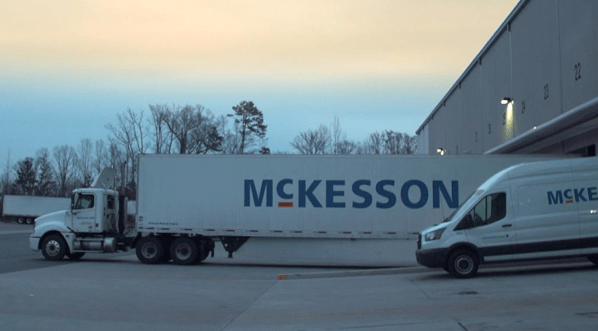
Offline advertising options include outdoor billboards, or as is the custom with wholesale suppliers, even a company’s name on its huge cargo trucks can work wonders for its awareness. You can always think of creative merchandising options and other relevant associations, name-boards on top of relevant shops, for instance, to pan out your presence in any region you choose.
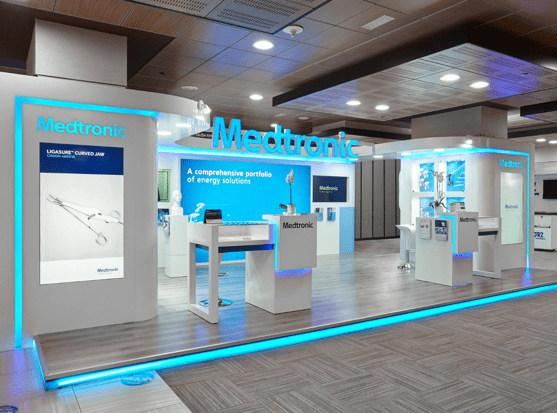
The most important, however, is events and conferences. You must have an impressive display at the place where you will meet most of your prospective buyers. Medical fairs and exhibitions are most worthy of your attention in offline advertising. Have a look at these images to see what I am talking about:

5. Think long-term
This might sound philosophical, and it might be. But the fact remains, it is important. Get the insides right. Provide logistical convenience, efficiency, superiority. Have processes; follow them. Build Loyalty and Reward Programs, and take other initiatives to improve CLV (Customer Lifetime Value). Building customers takes time, make sure you retain them for at least a lifetime
Deliver on your promises. Be persistent, play the long game. Ensure that your products, services and intangibles meet and exceed customers’ requirements.
The companies we observed above did not build their reputations overnight. Neither can you.
Conclusion
In this article, we saw what Indian companies in B2B medical equipment and supplies segment can learn from their global peers. We covered 5 points in all, which were:
- Maintaining active and relevant social media presence,
- Positioning on ‘cause’ basis
- Enabling continuous back-end enhancements
- Marketing offline
- Long-term decision-making
With these points in mind, Indian companies have the perfect opportunity to capitalize on the market and carve out the biggest medical equipment share. Creating a globally-recognized brand and business is just the next natural stage from there.
 HealthcareSolutions